In-situ analysis of rheological and electrochemical properties of carbon nanoparticle suspension
ACS Applied Engineering Materials
Abstract
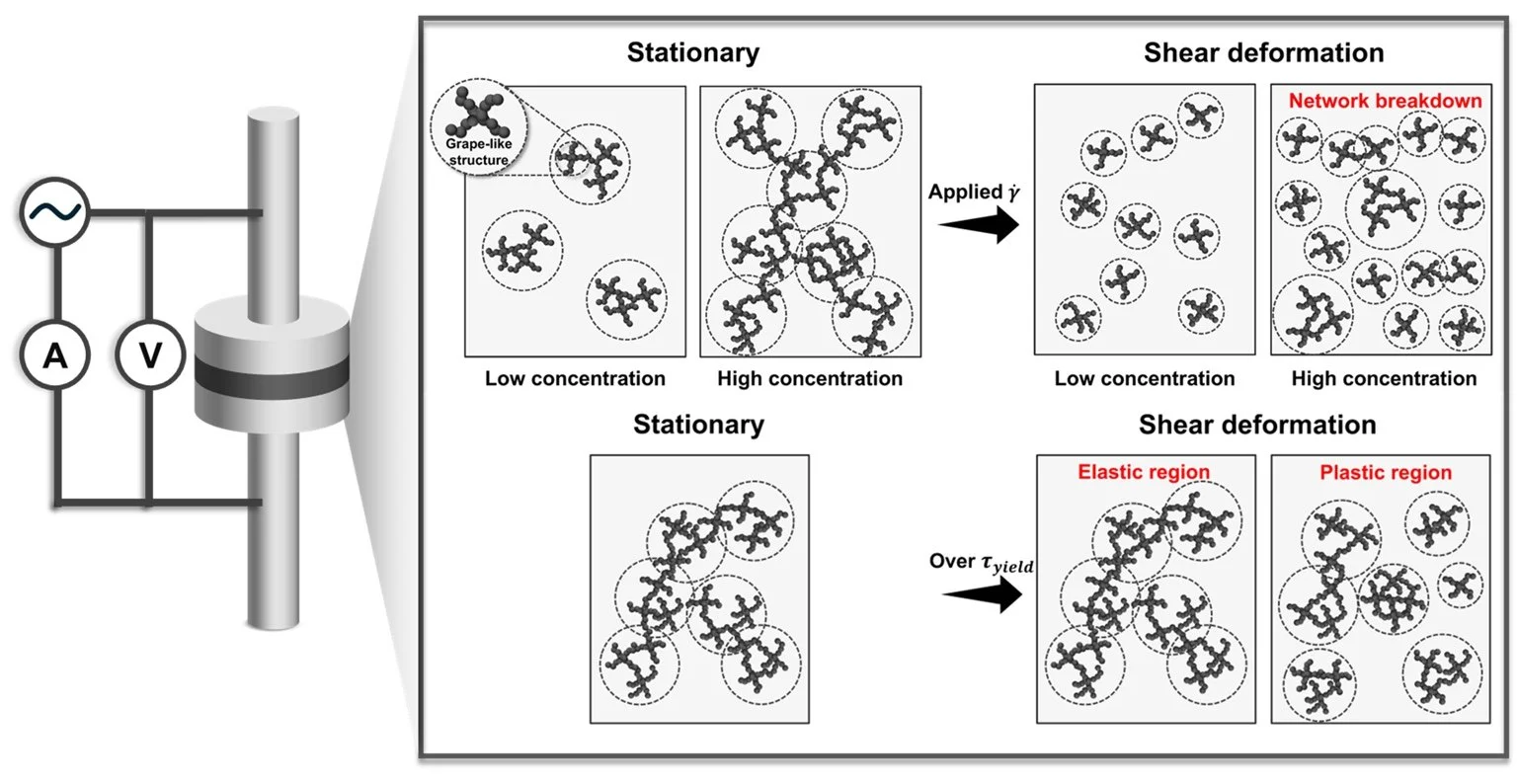
Understanding the internal structure of materials is crucial for developing and optimizing chemical and mechanical processes. Rheological analysis has elucidated the internal structure and interactions of complex material systems. However, this analytical method faces difficulties in sample preparation and measurement. In this study, an in-situ combination of rheological measurement and electrochemical spectroscopy was introduced to investigate the internal structure of carbon black dispersed glycerol suspension. The electrochemical characteristics of the suspension were measured with respect to the shear rate and shear stress. The Nyquist plot was also analyzed according to the particle concentration. At a low concentration, the resistance decreased with an increase in the shear rate, while at a high concentration, the resistance increased. These results are attributed to the resistivity change of glycerol and the destruction of the network structure of carbon black particles. In addition, an abrupt increase in impedance was observed when the applied shear stress exceeded the yield stress.
Keywords:
Internal structure Rheology Electrochemistry In-situ analysis method Electrochemical Impedance Spectroscopy (EIS)
Published:
March 22, 2025
Citations: 3
Research aim
This research aim to investigate the internal structure of nano-particle suspension by rheological and electrochemical analysis method. Rheology is powerful theory for detecting material properties, nevertheless it is not proof enough for any phenomenon being observed by itself. For a thorough experimental study, it always needs to be coupled with electrical, thermal, or optical methods. In this work, I was focused on integrating both rheology and electrichemical analysis to overcome limitations of conventional techiques.