Characterization of polycaprolactone/Ti3C2TX MXene nanocomposites fabricated via injection molding
Polymer
Abstract
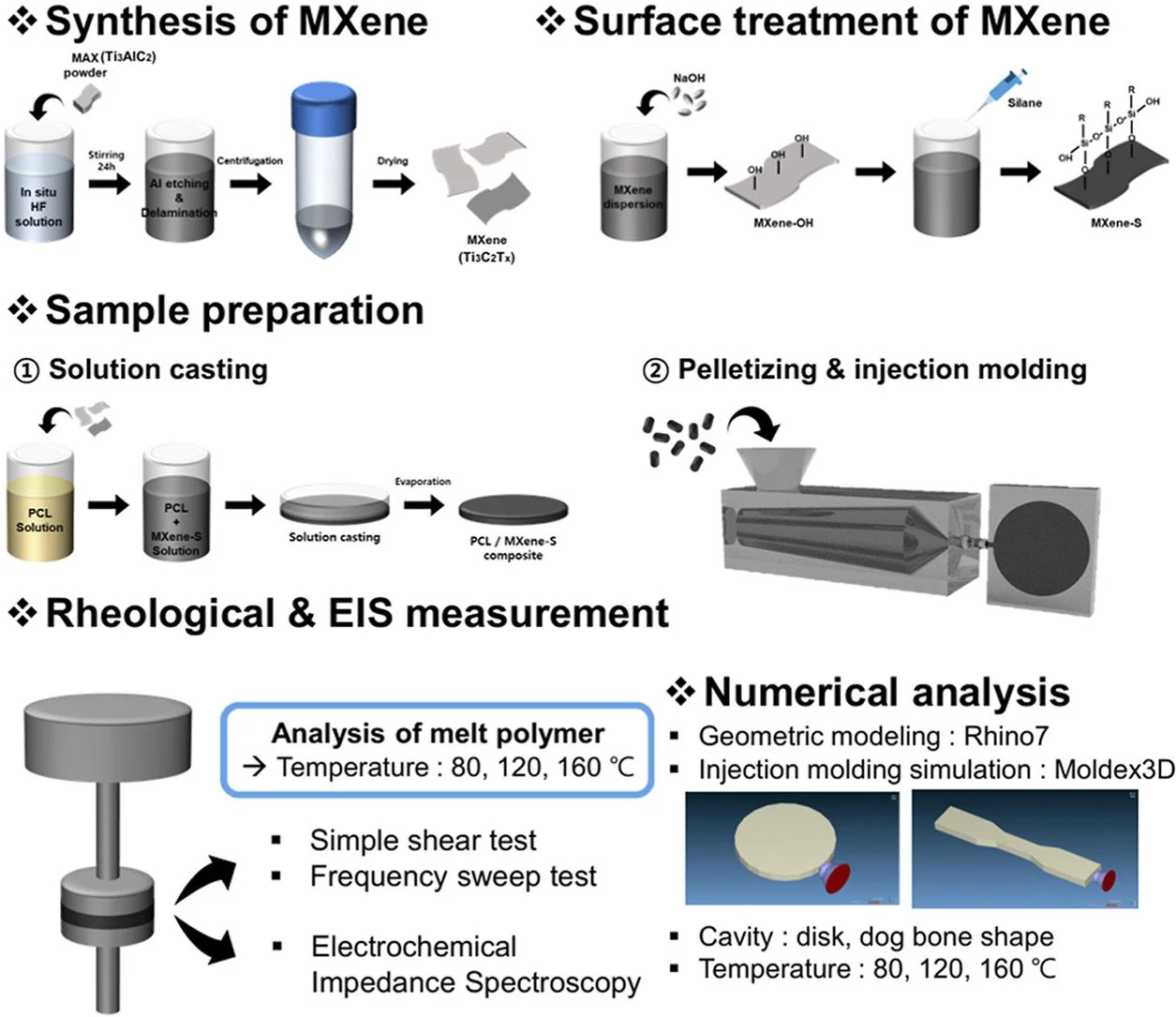
Polycaprolactone (PCL) has garnered attention as one of the most important biodegradable polymers due to its biocompatibility, tissue compatibility, and high flexibility. To enhance its applicability in bioelectronic materials, the low conductivity and mechanical properties of the polymer need to be improved. In this study, polycaprolactone-based nanocomposites containing MXene particles were prepared by using injection molding. The hydrophilic feature of MXene results in poor dispersion in non-polar organic solvents and low compatibility with hydrophobic polymers. The MXene particles were subjected to surface treatment to achieve the strong interfacial adhesion between the filler particles and the polymer matrix, as well as the excellent dispersion of the filler. Physical and chemical characteristics of the nanocomposites analyzed. Furthermore, rheological and electrical analyses of the polymer melt were conducted to examine the internal structure of the MXene-embedded polymer nanocomposites. The results showed that the addition of a small amount, specifically 0.5 wt%, led to a significant improvement in both the mechanical properties and the electrical conductivity. In addition, the flow and deformation behavior of the molten polymer in the cavity were evaluated through injection molding simulation.
Keywords:
Polycaprolactone (PCL) MXene Nanocomposite Injection molding
Published:
November 10, 2025
Citations: -
Research aim
Conductive polymers have been studied because electrical stimulation can promote cell adhesion, proliferation, and growth. However, due to their low biocompatibility, they cannot be used as biomaterials alone. Therefore, much effort is ongoing to impart conductivity by adding conductive particles to biopolymers for use as bioelectronic materials. The limitation of PCL as a bioelectronic material can be overcome by preparing nanocomposites with conductive particles such as MXene. Therefore, we attempted to enhance the mechanical and thermal properties of PCL/MXene composites and applicate theinjection molding process of the nanocomposites.