Injection-molded PEO/MXene nanocomposite for polymer-based solid-state electrolyte
Composites Communications
Abstract
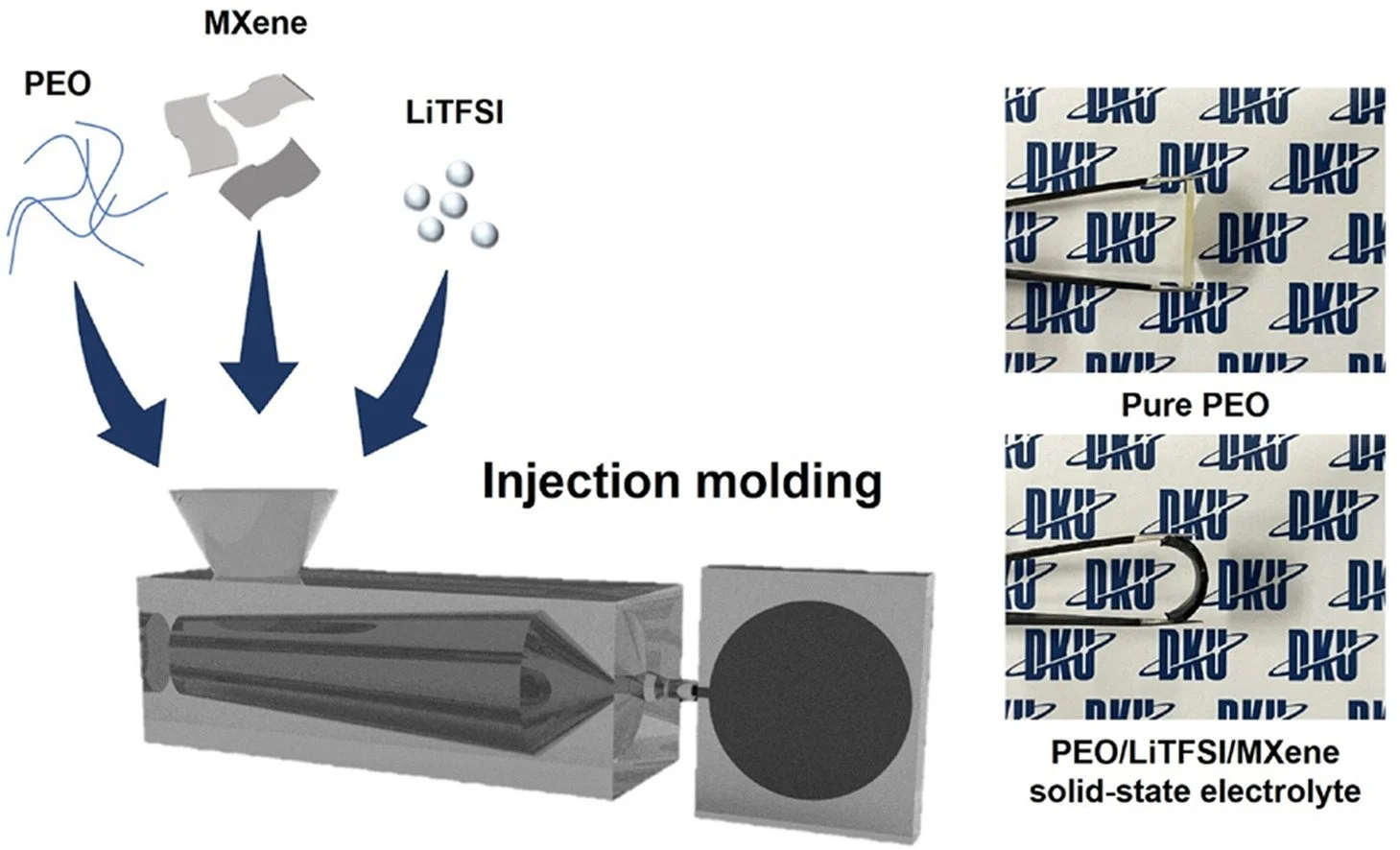
The solid-state electrolyte constitutes a major component in an all-solid-state lithium-ion battery. It plays a critical role in determining the lifetime and performance of the battery. Among the materials used in polymer-based solid-state electrolytes, poly (ethylene oxide) (PEO) is widely studied due to its high ionic conductivity and excellent solubility in lithium salts. However, the high crystallinity of PEO still remains a challenge to overcome, leading to poor ionic conductivity compared to other solid-state electrolytes. Herein, we fabricated MXene-embedded PEO nanocomposites for solid-state electrolytes using the injection molding process. MXenes were synthesized by using HF and MILD etching methods. The particle characteristics were evaluated through morphological, elemental, and structural analyses. In addition, the thermal, mechanical, and rheological properties of the solid electrolyte were examined. The solid-state electrolyte was injection-molded, and the flow and deformation of the molten polymer were modeled numerically. Also, the performance of the lithium-ion battery was simulated. The addition of MXene resulted in an approximately 80 times improvement of ionic conductivity, i.e., 1.0 × 10^-4 S/cm.
Keywords:
Poly(ethylene oxide) (PEO) MXene Nanocomposite Injection molding
Published:
July 17, 2024
Citations: 17
Research aim
PEO shows high ionic conductivity and excellent solubility in lithium salts which leads to good suitability to solid-state lithium-ion battery. However, the PEO has a limitation that its high crystallinity interuptted to applicate for solid-state lithium-ion battery. Therefore, we suggested PEO/MXene composite to overcome this limitation. In addition, considering ease of use in the actual process, we conducted experiments using the injection molding method.